


The New Rules of "Just Looking": What to Expect When You Ask for a Home Tour
So you've been scrolling through Zillow at 11 PM (we've all been there), you found a house you love, and now you want to see it in person. You pick up the phone, call the listing agent, and ask for a showing.
Here's the thing: The conversation that follows is going to be very different than it was a few years ago.
Welcome to real estate in 2026, where "just looking" has a whole new set of ground rules.
The "Big Three" Questions You'll Get Asked
When you call an agent to schedule a private tour, don't be surprised when they hit you with three questions before you even get to "What time works for you?"
Question #1: "Are you currently working with another agent?"
This isn't nosy, it's professional courtesy. Agents respect each other's relationships with clients, and they need to know if you're already committed to someone else. If you are, they'll politely suggest you contact your own agent to set up the showing.
Question #2: "Have you signed a buyer-broker agreement with anyone else?"
This is the follow-up. Even if you've been casually texting with your cousin's friend who sells real estate, if you've signed paperwork, that's a legal relationship. The agent on the phone needs to know this before moving forward.
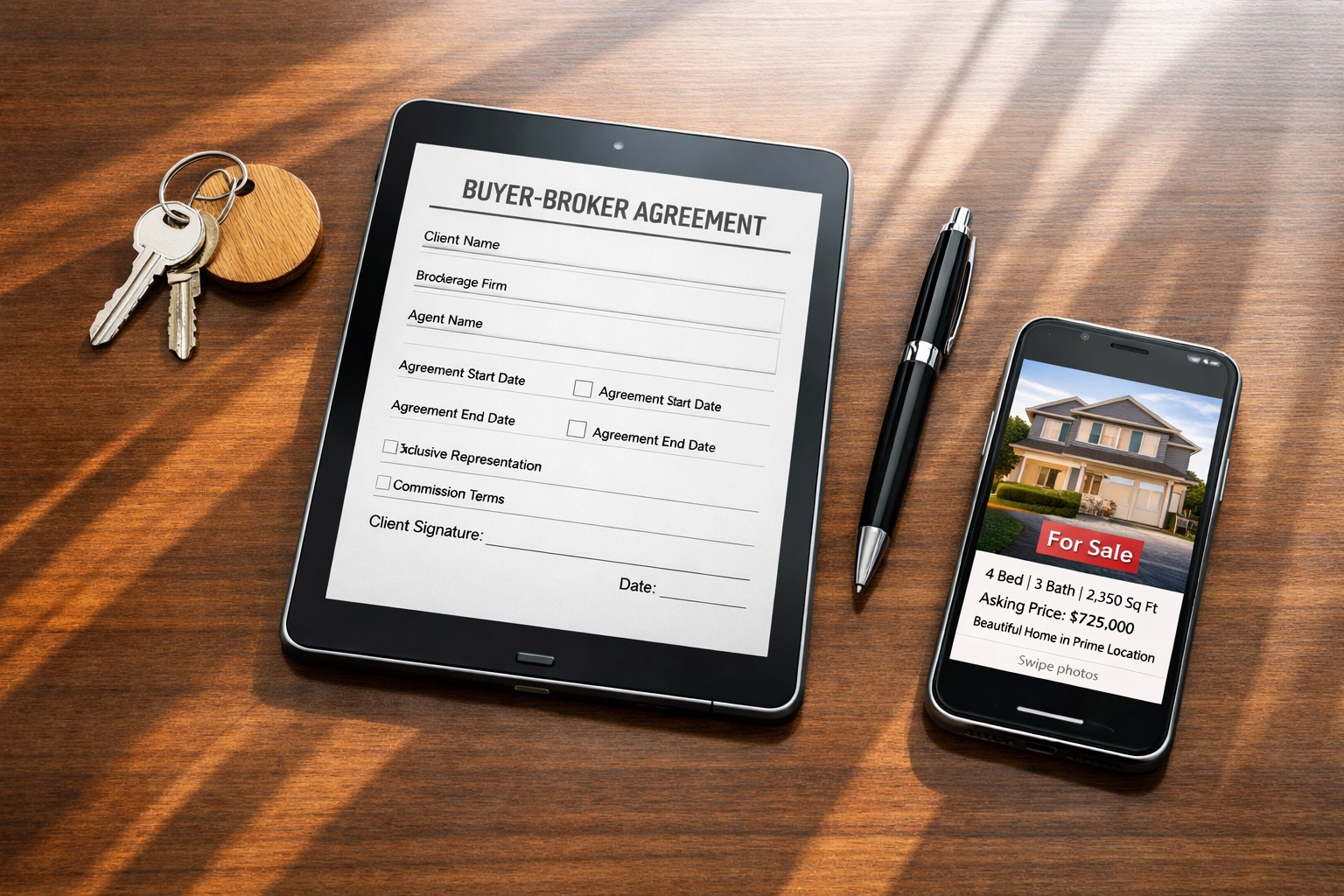
Question #3: "Are you aware of the recent law changes that require a signed buyer-broker agreement BEFORE we can tour a property?"
And here's the big one. This isn't the agent being difficult, it's literally the law now. Recent changes in the real estate industry mean that buyer's agents must have a signed agreement in place before stepping foot inside a property with you. It's a requirement, not a suggestion.
Think of it like a contractor who won't start work without a signed contract. It protects both parties and clarifies expectations from the jump.
Understanding the Two Stages of Being a Buyer
Here's where we need to get real for a second: There's a massive difference between browsing and buying, and the real estate process now reflects that distinction.
Stage 1: The "Just Browsing" Phase
You're scrolling. You're dreaming. You're getting ideas. Maybe you're wondering if you can afford to move, or you're just curious about what's out there. You haven't talked to a lender yet, and you're definitely not ready to write an offer next week.
This stage is perfectly normal, and it's exactly what online resources are designed for!
This is when you should be:
Watching 3D Matterport virtual tours that let you walk through a home from your couch
Checking out drone videos to see the neighborhood and property layout from above
Exploring single-property websites with all the details in one beautiful place
Attending open houses where you can walk through without commitment
The truth? If you're still in the dreaming phase, asking for a private showing isn't the right move, for you or the seller. You're not ready to commit to an agent relationship, and the seller doesn't need people wandering through their home who aren't in a position to buy.
Stage 2: The "Serious Buyer" Stage
Now we're talking! You've:
Talked to a lender and know your buying power
Got your funds verified (whether that's a pre-approval letter or proof of cash)
Identified your must-haves and deal-breakers
Narrowed down neighborhoods and price ranges
You're ready to pull the trigger when you find the right property
This is when private showings make sense. You've done your homework online, you've eliminated properties that don't fit, and now you're ready to experience the finalists in person before making an offer.
At this stage, signing a buyer-broker agreement isn't a burden, it's a formality that gets you in the door with professional representation.

Why This Actually Helps Sellers, Too
If you're thinking, "This sounds like a hassle," consider it from the seller's perspective for a moment.
When I list a home with premium marketing, 3D tours, drone footage, a dedicated property website, I'm not just showing off. I'm filtering.
Here's what happens: Buyers tour the home virtually first. They see every room, every angle, every detail. They check out the backyard from above. They explore the neighborhood virtually. By the time they request a private showing, they've already fallen in love with what they've seen online.
That means the people walking through my seller's front door are SERIOUS.
They're not "just curious." They're not comparing 47 different houses in person. They've already vetted the property digitally, and now they want to confirm what they already believe: This might be the one.
For sellers, this is huge. It means:
Fewer disruptions to their daily life
Less wear and tear from random foot traffic
Higher-quality showings with motivated buyers
A faster path to a real offer
The Stephen Powell Advantage: Premium Marketing That Does the Heavy Lifting
This is where my approach really shines.
I list homes at a 2% commission, that's a full percentage point less than the typical 3% listing fee. But here's the thing: I don't cut corners on marketing to make that work.
Every one of my listings gets: ✓ 3D Matterport virtual tours so buyers can explore 24/7 ✓ Professional drone video showcasing the property and surroundings ✓ A dedicated single-property website that looks like a luxury listing ✓ High-end photography that makes people want to see more

Why does this matter for the "new rules" conversation?
Because my marketing is so thorough, buyers can do 90% of their elimination process online. By the time they're calling for a showing, they're past the "just looking" phase. They've already decided your home is worth their time, and yours.
And for sellers? You're saving thousands on commission while still getting marketing that rivals (or beats) what agents charging 3% provide. You're not sacrificing quality, you're getting smarter service at a better price.
How to Prepare for Your First Showing Request
If you're a buyer reading this and thinking, "Okay, I'm in the serious stage: what do I do?", here's your game plan:
Before you call an agent:
Get pre-approved by a lender (or have your cash verified)
Tour homes virtually using 3D tours and video
Make a shortlist of properties you're genuinely interested in
Be ready to discuss your timeline and what you're looking for
When you call:
Be upfront about whether you're working with another agent
Ask what the buyer-broker agreement entails (a good agent will explain it clearly)
Share your qualifications so the agent knows you're ready
Respect that this is now a professional relationship with mutual commitments
The bottom line? The days of calling 10 different agents to show you 10 different houses while you're "just thinking about maybe moving someday" are over. And honestly? That's better for everyone.
The Real Estate Industry Grew Up: And That's a Good Thing
Look, change feels uncomfortable at first. But these new rules are actually about respect, clarity, and professionalism on both sides.
Buyers get clear representation and protection. Agents can focus their energy on serious clients. And sellers get higher-quality showings from motivated buyers who've already done their homework.
If you're selling your home and want marketing that works WITH these new rules instead of against them: marketing that filters out the casual browsers and attracts serious buyers: let's talk.
With premium 3D tours, drone video, and a 2% listing fee, I help sellers net more while attracting better-qualified buyers from day one.
Because in 2026, smart marketing isn't just about getting eyeballs on your listing. It's about getting the right eyeballs: the ones attached to buyers who are ready, willing, and able to make a move.
That's how we sell homes faster and for more money in today's market. No gimmicks. No shortcuts. Just professional service that respects everyone's time: and your bottom line.
Comments